On 3 June 2026 the World War 3 team posted four short paragraphs to Steam.
Operators,
We have an important update to share regarding World War 3.
After careful consideration, we have made the difficult decision to end support for the game and shut down its servers.
The World War 3 servers will be taken offline on 3 August 2026. After this date, the game will no longer be playable.
This was not an easy decision. You have supported us throughout the years and we want to thank everyone who played World War 3, shared feedback, reported issues, created content and kept the community alive.
Thank you for being part of this journey.
The World War 3 Team
The servers went down on schedule. Eight years, two launches, three publishers. Almost nothing that killed World War 3 was about how it played.
What they were trying to build
The Farm 51 is a Polish studio in Gliwice with a back catalogue of mid-budget shooters: Painkiller Hell & Damnation, Deadfall Adventures, Get Even. What set them apart was photogrammetry. They had spent years scanning real places, most famously the Chernobyl exclusion zone, and they were good at it.
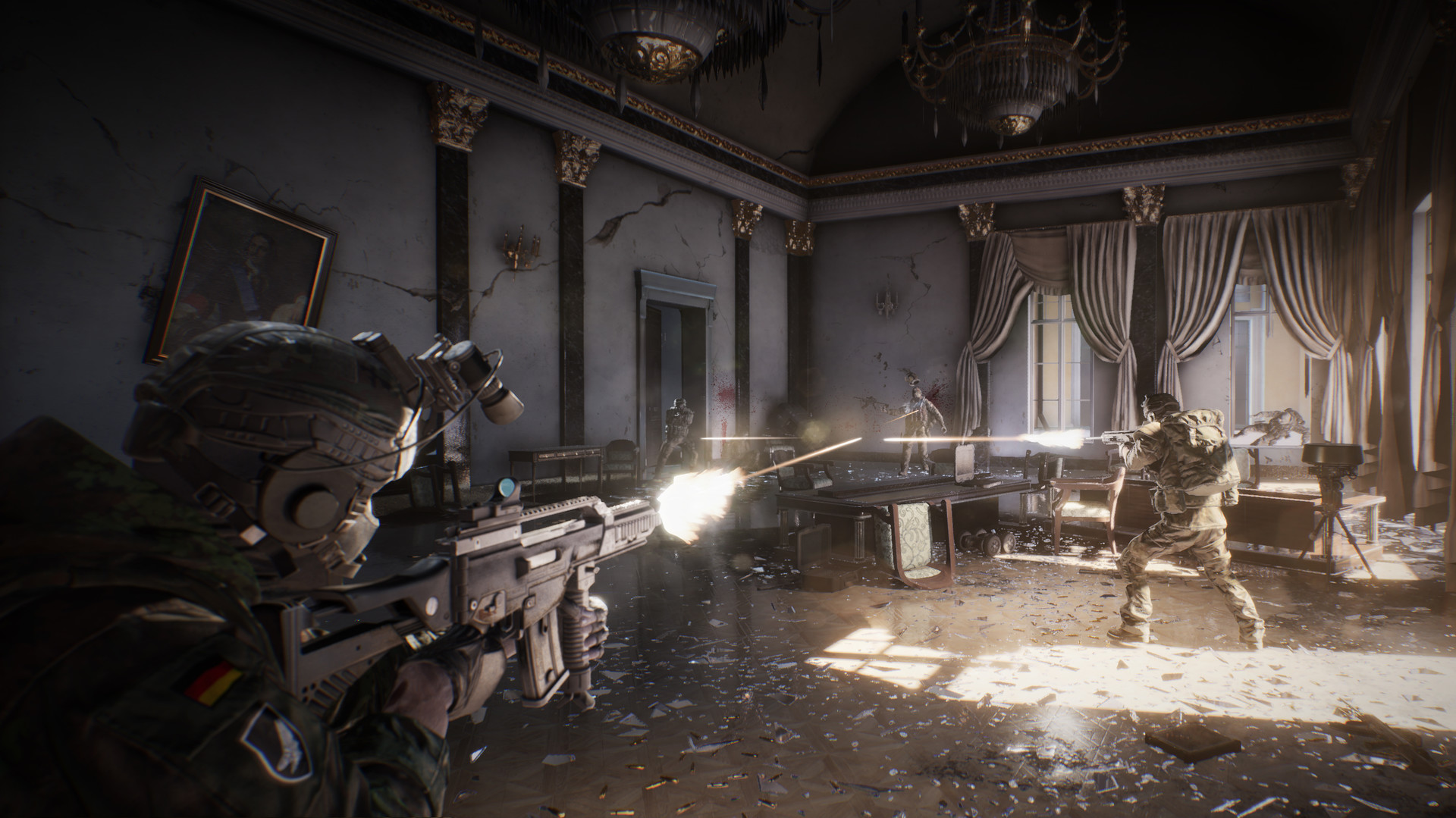
World War 3, announced in May 2018, was that skill pointed at a near-future global conflict. Real cities, scanned and rebuilt as maps: Warsaw, Berlin, Moscow, Smolensk, Polyarny, Tokyo, Istanbul, the Korean DMZ, the Gobi Desert.

Ballistics and armour penetration developed with military consultants. Full-body awareness, vehicle physics, and a customization system deep enough that the marketing counted combinations in the millions. They called the target "playable realism".
On top of the shooter sat a strategic layer. Every match fed a persistent war map, so a Warzone round in Berlin moved a front line that every player shared, with resources and territory changing hands as a result. There was also Recon, a squad-based battle royale mode, because it was 2018 and everything had one.
The timing looked genuinely good. Battlefield V was about to land badly that November, and a harder-edged alternative from an independent studio had an opening. The problem was the shape of the commitment: DICE's feature list, an MMO-style metagame, and a live backend, from a team of around sixty people who had never operated a live service. Early Access was how they were going to pay for it.

The launch worked. Then it didn't.
World War 3 hit Early Access on 19 October 2018 and sold more than 100,000 copies in 48 hours, topping the Steam charts. It peaked at 11,021 concurrent players that month.
Then the master servers fell over. Players sat on loading screens, got dropped mid-match, crashed out. Patches went out almost daily for the first week and the studio committed publicly to crushing every reported bug. The concurrency tells the rest: an October daily average of 3,811, then 900 in November, 357 in December, and 51 by the end of 2019.
The team rebuilt the fundamentals in public. New movement system, new animation system, a reworked damage model, Linux servers, 47 weekly reports. In February 2020 they merged regions, because there were no longer enough players to fill regional queues. Every one of those is a defensible engineering call, and every one of them was made while the players they were meant to win back were leaving.
For a multiplayer shooter the scarce resource is population. Matchmaking is a function of how many people are online right now, so every month spent fixing the game costs part of the audience you need in order to test the fix. A region merge is the moment the spreadsheet admits it.
Going dark
In April 2020 MY.GAMES came in as publisher. The framing was that it gave The Farm 51 "the necessary resources and expertise to expand the scale of their upcoming title, while retaining creative control and vision", in the words of creative director and co-founder Kamil Bilczyński. Four months later, on 13 August 2020, the game came off sale. Existing owners kept their servers, but nobody new could buy in. Development, the announcement said, was moving "outside of a live environment".
By February 2021 the game averaged 12 concurrent players. It stayed roughly there for two years.
Pulling a shipped game off the market to rebuild it for two years is a call most studios never get to make. The Farm 51 could only make it because a publisher was funding the silence.
The second launch also worked
The rebuild came back on 26 September 2022 as a head start for existing owners, then open beta three days later, free to play. It peaked at 11,623 concurrent players, higher than the 2018 launch. On 10 December 2022 it left Early Access as 1.0.
Then: 4,084 daily average in October, 1,705 in November, 1,387 in December, 1,132 in January 2023, 179 by that December. The same curve as 2018, four years and one full rebuild later.
Both launches proved The Farm 51 could acquire an audience. Neither proved anyone could keep one, and for a free-to-play shooter that is the only question that matters. Two rebuilds bought two first days.
The same month as the relaunch, VK sold MY.GAMES to Alexander Chachava for $642 million and the publisher restructured itself out of Russia. A game called World War 3 spent its second launch window attached to a publisher being extracted from Russia in September 2022.
Three publishers deep
In December 2023 Wishlist Games acquired the development rights from MY.GAMES. Its CEO, Alexey Larionov, had been the MY.GAMES producer fielding community AMA questions about World War 3 back in 2020, so at least one person followed the game across three owners.
The handover took eleven months. Rebuilt backend systems, every player's progress migrated, install size cut from 116 GB to 92 GB, distribution moved to the Steam CDN, Easy Anti-Cheat added. Larionov called it a massive undertaking and said it was necessary to give the game a foundation to grow on. It was announced complete on 4 December 2024, with development now credited to New Generation Games and The 4 Winds Entertainment co-publishing in Turkey and the Middle East.
Eleven months of skilled work, and not one hour of it was content a player could see. Every change of owner costs a year that looks like that one, and a live game which ships nothing for a year is spending down the only thing it has.
2025 was an actual live-service year. Patch 1.3, then 1.4 in June, then 1.5 on 11 August, new operators, a tutorial video series running into late October. Then open the Steam announcements feed and look at what follows: two maintenance notices in March 2026, and the shutdown post. The ending was legible in the news feed ten months before anyone announced it.
The numbers at the end
In July 2026 the game averaged 25 concurrent players, peaking at 63. Its Steam page carries 54,567 reviews, 53.7% of them positive, a Mixed rating that took eight years of arguing to produce.
Twenty-five players cannot fill a 40-player mode. A shooter that far below its own population floor stops being playable well before anyone switches it off, which is why the announcement read less like a decision and more like paperwork. There are no refunds for in-game purchases. The money, the operator said, went to servers, updates and support, which is both true and the standard answer.
The Farm 51 did not outlast the game. On 2 April 2026, after Chernobylite 2: Exclusion Zone landed badly in Early Access and about a third of the staff had already been let go, the studio filed for bankruptcy and started looking for an investor. The developer went under four months before the game it made was switched off, and by then the two had nothing to do with each other.
What is actually gone
There is no offline mode, no LAN, no private server binary. Eight years of scanning, animation and iteration, plus whatever players spent on it, is now a 92 GB folder that no longer opens. Everyone involved made defensible calls at the time and the game still evaporated on a Monday morning.